Despite the complete absence of a tradition of standing armies or other institutions and practices of government in western Arabia—the region where Islam emerged—the early Islamic state expanded rapidly and suddenly in the seventh and eighth centuries. Explaining this expansion has long posed a challenge for historians due to three factors: the multifaceted nature of this complex phenomenon, serious gaps in the evidence from historical sources on the subject, and current terminological confusion and inadequacy
Fred M. Donner
Peter B. Ritzma Professor Emeritus of Near Eastern History, University of Chicago
The rapid and unheralded expansion of the early Islamic state in the seventh-eighth centuries CE is generally seen as a turning point in world history, but explaining it has long posed a challenge for historians. Beginning in Arabia shortly before the death of the prophet Muhammad in 632 CE, and accelerating after his death, the movement started by him expanded quickly under his first successors—called amir al-mu’minin or “commander of the Believers” in the earliest documents—to encompass vast areas around the Mediterranean basin and far to the east of it, all the way to India. Yet this movement originated in western Arabia, a region that lacked a tradition of standing armies or other institutions and practices of statecraft, that offered meager economic resources to support conquest and expansion, and that was culturally underdeveloped, with only small towns and no established centers of literary activity. Nonetheless, this new movement engulfed the Iranian empire of the Sasanians, seized key provinces from the Later Roman (Byzantine) empire, and continued to expand for more than a century. How could this have happened?
Efforts to understand these events—usually subsumed under the blanket term the “rise of Islam” or simply “the conquests”—are hampered by three factors: the multi-faceted nature of this complex phenomenon, serious deficiencies in sources of historical evidence for it, and modern terminological confusion and inadequacy. First, as a historical complex, the “Rise of Islam” includes, at the very least, the coalescence and rapid expansion of a new state that arose in a part of Arabia that had hitherto been stateless, and that took over vast new areas beyond Arabia; the emergence of a new religion, Islam, and its gradual spread through the conquered territories; the crystallization of a panoply of new state institutions (including military forces, military garrisons and settlements, a structured hierarchy of governance, a tax administration, and a judiciary); the migration over a prolonged period of many peoples originally from Arabia or nearby Syria and Iraq into other areas; the establishment and continuing evolution of relations between the new rulers from Arabia and the huge and diverse populations they now ruled outside Arabia; and the spread of a new official administrative language, Arabic, that had hardly been written before, at least outside Arabia itself, and its development into a vehicle for sophisticated cultural expression of all kinds. Second, understanding this daunting list of phenomena is made difficult by the fact that contemporary documentary evidence from the time of the conquests themselves is limited in quantity and extremely uneven in coverage (relatively rich but far from complete for Egypt, much more limited for Syria, Iraq, Iran, Arabia, and North Africa). Literary sources such as chronicles provide important information, but these sources are mostly products of later centuries, and sometimes project back onto the early period values or biases of those later times, so we are not always sure whether what those sources tell us is factual data about early events, or merely the wishful thinking of later apologists or critics. This uncertainty is sometimes even reflected in the very terms used by these sources to describe events—terms that are sometimes inaccurate but, because found in the later literary sources, are utilized and popularized by modern writers. For example, it now seems clear that the earliest followers of the new movement begun by Muhammad did not at first call themselves “Muslims” (muslimun) or their movement “Islam.” Rather, they referred to themselves as “Believers” (mu’minun), and evidence from the Qur’an makes clear that the two terms, Believers and Muslims, while related, were not originally identical in meaning. Similarly, there are no early documentary sources that refer to the first conquerors as Arabs. Yet—and here we encounter the third problem—modern authors often continue to discuss these events under the rubrics of the “Islamic conquests” or the “Arab conquests.” It remains unclear just what we should call them, so the terminological difficulty remains. Then there is the very nature of the expansion itself: was it at heart a religious movement, or was it a movement of ethnic (Arab?) consolidation, or was it driven by other factors entirely? And in what measure is this expansion best described as a “conquest” when many of the “conquered” peoples and communities ¯seem quickly to have made peace with and adapted to the new regime, whether or not they became Muslims?
This short essay cannot adequately address any, much less all, of these challenges. We shall touch on some of them in slightly more detail below, but readers should always keep these issues in mind when reading about the “Rise of Islam” and “the conquests.” What follows is an attempt to provide a brief panoptic view of the general contours of the topic, based mainly on the evidence provided by later literary sources, controlled when possible by evidence from early documents. Our essay breaks the subject down into two discrete phases, followed by a section on Islam’s entry into the Iberian peninsula in the eighth century CE., and concludes with a brief reflection on several broad issues raised by the conquests themselves.
Phase I: 632-660
The earliest phase of the expansion, following immediately upon the death of the prophet Muhammad in 632 CE, is the most difficult to understand for the reasons just described. The general course of events is usually outlined more or less as follows. In the last two years of Muhammad’s life, he and his followers, the Believers (mu’minun), had brought much of western Arabia under their control from their base in Yathrib (Medina), subduing the many tribes of the region and its other key towns (Mecca, the prophet’s home town; al-Ta’if, Khaybar, Yanbu‘, Tayma’, and others). Upon Muhammad’s death, some tribal groups repudiated the agreements they had made with him to pay tribute, and some even planned to march against Medina itself. Muhammad’s followers, after negotiating among themselves, agreed to remain a unified multi-tribal polity, and to recognize his father-in-law Abu Bakr as their political leader, or amir al-mu’minin (“commander of the Believers”—later referred to as caliph, from Ar. khalifa, “deputy” or “successor”). Abu Bakr (r. 632-634 CE) organized military forces that turned back the immediate threat to Medina, and then proceeded to send columns of armed men into various parts of Arabia to enforce the allegiance of local tribes and communities to Medina, to collect tribute, and to gather further recruits. These campaigns in Arabia, which lasted for roughly two years, are known collectively in the later Muslim chronicles as the “Wars of the ridda” (turning away, apostasy). In many cases, the mere arrival of Medina’s forces was enough to persuade a tribal group that had been wavering to reaffirm its allegiance. In others, particularly in Najd and eastern Arabia, pitched battles were fought against recalcitrant tribes, some of which had never agreed to submit to Muhammad; among these battles were the clash with the Asad tribe of Najd and, above all, the battle of ‘Aqraba with the powerful Hanifa tribe of al-Yamama, in eastern Arabia, led by a rival to Muhamad named Maslama or Musaylima, and vilified in later Muslim chronicles as a “false prophet.”
The campaigns of the ridda wars brought all parts of the Arabian peninsula, even distant Yemen and Oman, for the first time under at least the nominal control of the Believers in Medina. Some of the forces that campaigned in northern Arabia then began to push further north, into southern Syria and Iraq, areas culturally much like Arabia but containing outposts and towns that were in territory claimed by the Byzantine (Later Roman) empire in southern Syria and the Sasanian Persian empire in southern Iraq. The local Byzantine and Sasanian frontier posts were surprised and overpowered by the appearance of these forces, coming from an unexpected quarter where no state had existed before to threaten them. The Believers’ first successes in places like Gaza and Bostra (in Syria) or al-Ubulla and al-Hira (in Iraq) can be seen as the beginnings of the “Islamic conquest” of the Near East, which was thus a direct outgrowth and continuation of the ridda campaigns in Arabia. These first conquests elicited the attention of the great empires, who began to organize stiffer resistance to ward off the invaders.
The prophet’s successor Abu Bakr died in 634, around the end of the ridda, and was succeeded as leader of the new state by another close companion of Muhammad, ‘Umar ibn al-Khattab (r. 634-644). ‘Umar in turn was succeeded upon his death by another companion of Muhammad, ‘Uthman ibn ‘Affan (r. 644-656) The later chronicles describe these rulers—‘Umar in particular—as organizing numerous armies under different commanders to attack Syria and Iraq, and to confront the new forces that the Byzantines and Sasanians were assembling. Between 634 and about 640, these various campaigns managed to seize most of the major towns and cities of Syria and Iraq, many of which capitulated without resistance, and to defeat in pitched battles the main Byzantine and Sasanian armies. Although the Arabian forces did suffer some defeats, they prevailed in several decisive battles—notably the battle of Yarmuk in south-central Syria, and the battle of al-Qadisiyya in southern Iraq–that shattered Byzantine and Sasanian resistance and delivered these areas into the hands of the Believers’ armies from Arabia. The chronology provided by the later chronicles is not absolutely reliable, but both of these battles appear to have occurred in about 636 or 637.
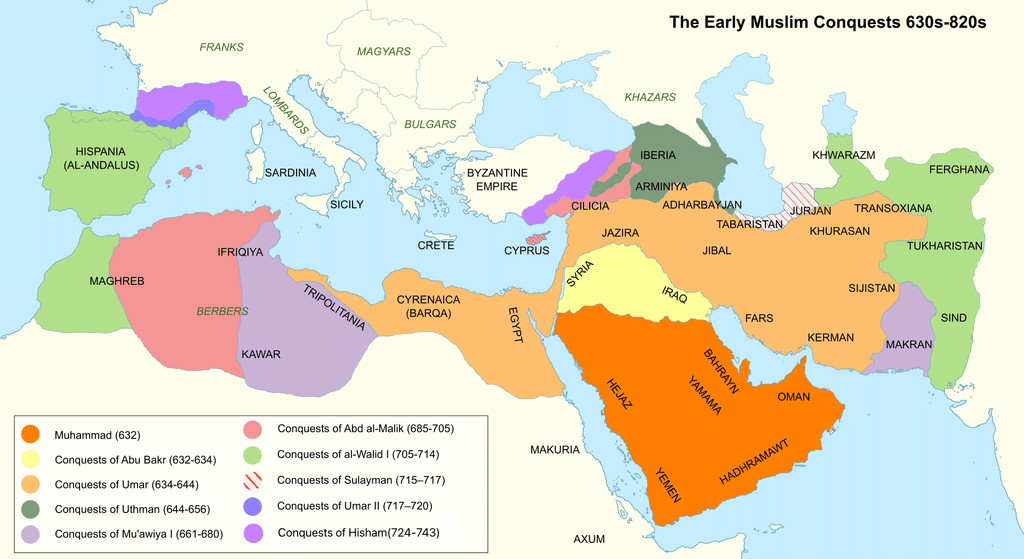
Following these decisive battles, the conquerors consolidated their rule in Syria and Iraq, bringing the remaining towns under their control (usually by treaty agreement), and beginning the process of collecting tribute and taxes. The newcomers proceeded to establish garrisons in the newly-conquered areas. These garrisons they called amsar (Ar. sing. misr, probably derived from a South Arabian word meaning “expeditionary force”). The initial function of these garrisons was to keep the Arabian forces together, thus reinforcing their mutual solidarity as soldiers and as members of the Believers’ movement, and so preventing them from assimilating into the vastly larger local populations they had conquered, which were usually Aramaic-speaking or Persian-speaking, and belonged to long-established communities of Christians, Jews, or Zoroastrians. These garrisons also served as strong points to contain any local uprisings and to ward of efforts at reconquest by the Byzantines or Sasanians. In Iraq, two main garrison towns were established at Basra in southern Iraq (close to the former town of al-Ubulla/Apologos near the head of the Persian Gulf) and al-Kufa in central Iraq (near the old town of al-Hira). In Egypt, the invaders, coming from Syria, established themselves near the old Roman/Byzantine fortress of Babylon at the head of the Nile delta, where their encampment grew into the city of Fustat (now engulfed in modern Cairo). To these garrisons came further Arabian recruits, or volunteers attracted by the success of the earlier campaigns, as well as the families of soldiers already there. The result was that these amsar in Iraq and Egypt grew quickly into large new cities, centers of military and civil administration of the whole province, centers of economic activity, and, as the years went by, important centers for the elaboration of a new Arabic-based Islamic culture. In Syria, the troops were garrisoned in vacant quarters of existing towns, particularly at Hims (ancient Emesa) in central Syria. There were no large new garrisons built in Syria resembling Kufa and Basra in Iraq, perhaps because fewer immigrant tribesmen ended up in Syria–it appears that the amīr al-mu’minin and his advisers in Medina, who always belonged to the tribe of Quraysh, wished to reserve Syria as much as possible for their own tribesmen and hence directed most recruits from other tribes to settle in Iraq or Egypt.
The amsar also had another important function; from them were launched continued campaigns of conquest farther afield, beyond Syria and Iraq. From Kufa and especially from Basra in Iraq, armies were dispatched annually into the neighboring Zagros mountains and Iranian plateau. This resulted in the final defeat of the remaining Sasanian forces that were attempting to regroup in the Zagros, at another decisive battle perhaps near Nihavand, and the ultimate collapse of the Sasanian regime (and death of the last Sasanian Great King at the hands of brigands). By the end of the 650s, many areas in western Iran, including the main towns, as well as the province of Khurasan in the northeast of Iran, had been brought under the control of the amir al-mu‘minin in Medina through these campaigns From Syria raids were also launched northwards, into northern Mesopotamia and Armenia, which were occupied, and also into central Anatolia, the heartland of the Byzantine empire; there, annual raids led to decades of border conflict but no permanent occupation north of Cilicia. From the garrison at Fustat in Egypt, campaigns were sent down the Nile and especially westward into Libya and North Africa.
The death of the caliph ‘Uthman in 656 led to several years of internal strife in the community of Believers, as rival claimants for the office of amir al-mu’minin—in particular the prophet’s kinsman ‘Ali ibn Abi Talib and ‘Uthman’s kinsman Mu‘awiya ibn Abi Sufyan of the Umayyad family—contended for leadership of the movement. This episode is commonly termed the First Civil War; in later Islamic chronicles, it is referred to as the first fitna, a Qur’anic term meaning “temptation” (presumably because during it, some leaders in the community were tempted by the lure of worldly power). During this period the raids and external campaigns of expansion stopped, as the rivals for leadership rallied the often reluctant soldiery under their command to fight one another.
At this point, we must pause our skeletal narrative of the course of conquest and try to explain these developments of the first phase—the astonishingly rapid expansion into the Near East of the fledgling new state of the Believers, based in distant western Arabia. The Believers seem to have been almost unstoppable in their military campaigns, even though they were confronting the well-established armies of the two most powerful states of western Eurasia, the Byzantines and the Sasanians. Moreover, the Believers managed in these twenty years to seize control over, and to retain, vast and important territories in which they were dwarfed in numbers by local populations that were probably a hundred times more numerous, if not more. How was this possible?
The initial raiding parties dispatched by Abu Bakr against the ridda seem likely to have been akin to the raiding parties that had been a recurrent, if irregular, part of Arabian tribal life for centuries: that is, they were ad hoc assemblies, limited in size, of tribesmen who were simply pastoralists or oasis farmers sent by a tribe or town for a brief time to participate in raiding a specific target, such as another tribe or town. In other words, such raiders were not full-time soldiers; and in the past, such raiding parties had dissolved once realizing their immediate objectives (or, often, before having done so). In this case, Abu Bakr’s immediate concern was to defend Medina against attack, and then to reassert Medina’s alliance with, or control over, the tribal groups that had earlier agreed to recognize in some way the prophet Muhammad’s authority—especially by contributing tax payments. Yet the long duration of the ridda campaigns, which kept fighters in the field under their commanders for two years in pursuit of a series of successively distant objectives, suggests that these forces were gradually being transformed into something more enduring. Whether simply through the experience of continuous campaigning, or whether in accordance with some preconceived plan, they evolved into a permanent force under clear command whose sole occupation was war campaigning; and their objectives seem also to have evolved, eventually leading them to attack and vanquish groups in Arabia that had never had any contact with the prophet Muhammad or made any agreement with him. By the end of the ridda, in other words, these forces, commanded distantly from Medina through the individual commanders appointed by Abu Bakr, had evolved into a standing army. After two years of campaigning in Arabia, furthermore, they were poised and ready to face the forces of the long-established Byzantine and Sasanian Empires. What those empires now confronted, in other words, were not irregular tribal or nomadic border raiders of the kind they had warded off periodically for centuries, but rather an organized and apparently disciplined military force, dispatched on the orders of what was emerging as a new state led by the amir al-mu’minin based in Medina. These considerations may help to explain how, in purely military terms, this astonishing series of victories could happen.
Less easily explained, however, are the motivations that drove the initial expansion in the first place. Were these conquerors from Arabia inspired by religious zeal, by ethnic or tribal chauvinism, by a thirst for plunder and wealth (including captives and property), or by the desire to realize a dream of political mastery? Since any social movement, to find widespread success, must appeal to people of many different temperaments, it is perhaps best to assume that all these factors in combination played some role, each weighing more or less decisively in the minds of different individuals. The traditional explanation proffered by later Muslim sources is that the conquerors were galvanized by the new faith of Islam, which they wished to spread far and wide at the expense of unbelievers. This, however, is overly simplistic, among other things because Islam as a faith at this time still consisted mainly of a few basic principles such as acceptance of strict monotheism, piety, and fear of the Last Day, which many people in other religions of the Near East at this time already accepted. It is also unrealistic to assume that everyone was motivated primarily by deep religious commitment, though some may have been. Apocalypticism—belief in the imminent coming of the Last Judgment—and other eschatological ideas were widespread in the Near East at this time, in all religious communities, and such notions may have contributed to a sense of religious urgency in the minds of those inclined to embrace it. But it seems likely that many participants were responding mainly to secular appetites or simply became swept up in the momentum of what developed into an inspiring and exciting adventure—a collective sense of solidarity and enthusiasm born of the movement’s early successes that the anthropologist Victor Turner termed “communitas.” It is also possible that what we might term an “expansionist imperative” came into play: that is, that in the absence of a regular flow of tax revenues to pay the soldiers, it was necessary to continuously move on to new sources of plunder in order to keep the troops loyal. During the ridda, as the forces sent from Medina subdued various Arabian tribes, they recruited new soldiers, so that the armies gradually grew larger, and depended ever more on further successful campaigns to provide the soldiery with both booty and basic supplies, and thus to prevent them from turning against their commanders or simply drifting away.

That there was some kind of religious component to the Believers’ expansion, however, can hardly be doubted. It is visible in the very first documentary evidence we have of the Believers’ movement, shortly after their arrival in Syria and Iraq: their first coins. These coins were modeled on Byzantine and Sasanian prototypes (because the Believers had taken over the Byzantine and Sasanian mints and re-used their coin dies), but they bear a new countermark saying, in Arabic, “In the name of God” (bism Allah )—a distinctly religious slogan. Perhaps this phrase was nothing more than a slogan, but then, if the slogan did not express something significant in the minds of the Believers, or at least of their leadership, why was it used it at all? On the other hand, there is no documentary evidence of religious compulsion by the early conquerors, in particular, no hostility to Christians; the patriarch of the Church of the East in al-Mada’in (Iraq), Ishoyahb III, even wrote to his bishops at the time that the conquerors “did not oppress Christianity, rather they praise our faith, honor the priests and saints of our Lord, and help churches and monasteries.” Moreover, new Christian churches continued to be built in what is today Jordan in the decades after the arrival of the Believers, as their dated mosaic floors show. What seems to have been demanded by the Believers when they took an area, then, was not religious “conversion” or conformity beyond the recognition of God’s indivisible oneness, but rather tribute or taxes as a token of political submission. Perhaps the goal, at least of those leading the movement, was to establish in the newly conquered lands what the Believers felt would be a more righteous and God-fearing political order than the sinful regimes of the Byzantines (with what the Believers considered their scandalous belief that Jesus was God and their odious Trinitarian doctrine) or of the Sasanians (who did not recognize the long line of revered prophets, including Abraham, Moses, and Jesus, that the Qur’an shared with the Jewish and Christian scriptures). Or maybe, particularly for some of the commanders and new governors, purely political considerations—the desire to establish and benefit from a stable and lucrative new state—was what mattered most.
The idea that these conquests were at heart an expression of an emerging ethnic identity as Arabs, in opposition to rule by non-Arabs, became widely accepted during the heyday of nationalist thought (in both Europe and the Arab world) in the nineteenth and early twentieth centuries—hence the common designation of these events in some Western literature as the “Arab conquest.” But it is striking that neither the Qur’an, nor any documentary sources for the first hundred years of the Believers’ movement, provides any solid evidence for a general Arab identity as a key motivation of the new regime. What we see instead for at least two centuries is a continuation of the intense tribal chauvinism and inter-tribal rivalry that had long divided the many tribes of Arabia and adjacent regions against one another. More important still, no early evidence portrays the new state as an Arab state or makes claims to be establishing Arab hegemony; rather the state is referred to in some early Arabic papyri as the “jurisdiction of the Believers” (qadā’ al-mu’minīn ). So it seems that in the first phase of the expansion, other motivations—religious, material, political, or psycho-social (“communitas”)—rather than ethnic ones, were predominant. Arab ethnogenesis, however, seems to have followed the conquests, as the conquerors from different Arabian tribes, realizing that they shared a language and culture that differed from those of the conquered peoples, gradually began to see themselves as a distinct ruling caste, as “Arabs.” But this nascent Arab identity seems to have remained for many centuries (until the late nineteenth century, in fact) mainly cultural and linguistic, rather than political.
On yet another level is the question of whether we should even consider the early expansion of the Believers to have been a unitary movement at all. It has been occasionally proposed that for a variety of reasons, different groups of Arabian tribesmen happened more or less simultaneously, but coincidentally and without any central coordination or direction, to have overrun different parts of the Near East, and only later were brought together under a centralized control that had initially been lacking. In other words, it is argued that what we call the “conquest” is a kind of back-projection from later times, to provide an explanation for a political coalescence that was essentially accidental. The initial conquest of Egypt by the commander ‘Amr ibn al-‘As is sometimes advanced to suggest that the amir al-mu’minin ‘Umar in Medina had no control over the various forces in the field. However, the chronicle reports that ‘Amr advanced on Egypt in violation of ‘Umar’s wishes do not seem particularly reliable; moreover, the chronicles also give numerous reports of generals and governors, even in distant provinces, being regularly called back and replaced by the amir al-mu’minin, suggesting a substantial measure of centralized control on a strategic level, even if distant commanders and governors enjoyed considerable freedom of action in their domain of action. The testimony of contemporary coins noted above also implies a common impulse to the movement in its earliest stages, expressed in key religious slogans. For these reasons, what we might term the “accidental thesis” does not seem persuasive as an explanation for the early expansion of the Believers’ movement. Rather, what does seem clear is that even the earliest conquests, and the new state that was taking form as the conquests unfolded, were quite closely directed by a very small group of people from the prophet’s tribe, the Quraysh of Mecca, a tribe that probably never numbered more than a few thousand people at any one time. It was from the Quraysh that the amīr al-mu’minīn was always chosen, as well as the majority of high military commanders. Around them were close associates from certain other West Arabian tribes, notably the Ansar of Medina (Yathrib) and the Thaqīf of al-Ta’if. Under them all were the tens of thousands of other Arabian tribesmen (and later, non-Arab clients [mawālī] or simple mercenaries who joined the cause even if they did not convert) who were recruited or attracted into the movement and made up the bulk of the conquest armies. It was apparently this small core group around the amīr al-mu’minīn who set policy and who benefited materially from the conquests, which brought them wealth and power beyond their wildest imaginings—benefits which many doubtless interpreted as proof of God’s favor for their cause.
Finally, we must consider what to call the first phase of expansion of the Believers’ rule into lands beyond their Arabian homeland—into Syria, Iraq, Egypt, and Iran—at a time when their state or government was itself just beginning to coalesce. This expansion is usually referred to in Western writings as the “Islamic conquests” or “Arab conquests,” but both terms are problematic because, as already noted, neither the term “Islamic” nor “Arab” seems to have been used in the ways we understand them today until the eighth or ninth centuries, a century or more after the conquests. On one level, we certainly must understand the expansion as a conquest, since the Believers did wrest vast territories from the Byzantines and Sasanians and others by force of arms in a number of pitched battles. The intrusion of an army into a new area always brings with it episodes of random violence perpetrated by undisciplined soldiers if not as part of policy, as has been attested in all historical periods; the famous episode of the “martyrs of Gaza” during the initial conquest of Palestine seems likely to be a typical case of this. On the other hand, as with many conquests in all times and places, many towns and cities simply capitulated to the invaders and proceeded to live under the new rulers in accordance with terms that they had negotiated with them. We must remember, then, that for many communities, the conquest involved not outright resistance, but rather accommodation or cooperation with the conquerors, which was in most cases a more prudent policy. The change of regime was a conquest, but not marked in every instance by the violence and brutality that the term ‘conquest’ sometimes implies. Acknowledging this would help avoid perpetuating the well-established but misleading stereotype that, as Gibbon suggested in the 1770s, Muhammad came “with the Qur’an in one hand and a sword in the other.” For, as already noted, the Believers did not demand of the people they took over conversion on pain of death or engage in religious coercion, and we know that at least in its early days the community of Believers in Medina even included at least some of Medina’s Jews. The new rulers from Arabia also drew on the talents of many local leaders (town headmen, tribal chiefs, bishops) and bureaucrats from the previous Byzantine or Sasanian empires in running their administration; usually these people, administrators but also even soldiers in the conquerors’ armies, remained Christians or Zoroastrians (about Jews in this period our evidence is too sparse to say anything one way or another). For many in these regions, who were already monotheists, being governed by the Believers, at least through the seventh century, may have been less troublesome for them in religious terms than Byzantine or Sasanian rule, which had been marked by inter-sectarian religious conflict and state meddling and coercion in the lives of their religious communities (e.g., of the Miaphysites of Syria by the Byzantine authorities).
Continue reading the rest of the essay in the next article.
Selected bibliography:
The works listed here offer clear presentations of some of the material described in the foregoing essay. The selection represents only the tip of the iceberg, as thousands of books and articles have been written on all the phenomena subsumed under the rubric of “the conquests,” and new works appear constantly.
- Bulliet, Richard W., Conversion to Islam in the Medieval Period: an essay in quantitative history (Cambridge, MA: Harvard University Press, 1979). An ingenious effort, largely persuasive, to address the difficult problem of tracing the pace of conversion to Islam.
- Collins, Roger, The Arab Conquest of Spain, 710-797 (Oxford: Basil Blackwell, 1989). A readable account of the conquest, marred by its refusal to integrate Arabic sources into its analysis.
- Clarke, Nicola, The Muslim Conquest of Iberia. Medieval Arabic narratives (London and New York: Routledge, 2012). Detailed study of the various Arabic sources for the conquest of al-Andalus.
- Donner, Fred M., The Early Islamic Conquests (Princeton: Princeton University Press, 1981). Views the conquests as part of a process of incipient state-formation, with a religious focus.
- _____, “Centralized Authority and Military Autonomy in the Early Islamic Conquests,» in Averil Cameron (ed.), Studies in Late Antiquity and Early Islam, 3: States, Resources, and Armies. (Princeton: Darwin Press, 1995), 337-60. Describes the hierarchy of conceptual, strategic, and tactical command during the conquests.
- _____, “Dīn, islām, und muslim im Koran,” in Georges Tamer (ed.), Die Koranhermeneutik Günter Lülings (Berlin: De Gruyter, 2018), 129-40. Explores how the Qur’anic usage of some key terms in the Qur’an differs from the meaning given them in later Islamic tradition.
- _____, “From Believers to Muslims: Patterns of Communal Identity in the Early Islamic Community, “ Al-Abhath 50-51 ( 2002-2003), 9-53. Makes the case that Islam began as a movement open to many monotheistic Believers, including Christians and Jews.
- _____, Muhammad and the Believers: at the Origins of Islam (Cambridge, MA: Harvard University Press, 2010). General overview of how Islam began.
- _____, Narratives of Islamic Origins: the Beginnings of Islamic Historical Writing (Princeton:
- Darwin Press, 1998). Views the Muslim conquest narratives as part of a broader process of legitimation in the Islamic community.
- _____, “The Qur’anicization of Religio-Political Discourse in the Umayyad Period,” Révue des Mondes Musulmans et de la Mediterranée 129 (2011), 79-92. How vocabulary from the Qur’an (7th century) was mobilized by Muslim scholars of later centuries to legitimize certain post-Qur’anic phenomena.
- _____, “Talking about Islam’s Origins,” BSOAS (Jan. 2018), 1-23. Discusses problems with sources and terminology relating to Islam’s beginnings.
- _____, “Visions of the Early Islamic Expansion: Between the Heroic and the Horrific,” in Nadia Maria El Cheikh and Shaun O’Sullivan (eds.), Byzantium in Early Islamic Syria (Beirut and El-Koura: American University of Beirut and University of Balamand, 2011), 9-29. How Muslim and Christian sources, for different reasons, emphasize the military aspect of conquest rather than accommodation, cooperation, or concession.
- Garcia-Sanjuan, Alejandro, “Denying the Islamic conquest of Iberia: A historiographical fraud,” in Fancy and Garcia-Sanjuan (eds.), What was the Islamic Conquest of Iberia? In Hussein Fancy and A. Garcia-Sajnuan (eds.), What was the Islamic Conquest of Iberia? Special issue of Journal of Medieval Studies 11/3 (2019), pp. 306-22. The title says it all.
- Hoyland, Robert G., In God’s Path: the Arab conquests and the creation of an Islamic empire (Oxford and New York: Oxford University Press, 2015). A clear overview of the long course of the conquests, arguing that it was part of a process of Arab ethnogenesis and (title notwithstanding) downplaying the role of religion.
- Kaegi, Walter Emil Jr., Muslim Expansion and Byzantine Collapse in North Africa (Cambridge and New York: Cambridge University Press, 2010). A comprehensive study of events in North Africa, based on careful analysis of Greek and Arabic sources.
- Kennedy, Hugh, The Great Arab Conquests: How the Spread of Islam Changed the World We Live In (Philadelphia: Da Capo, 2007). An excellent overview of this vast phenomenon.
- _____, Muslim Spain and Portugal. A political history of al-Andalus (London: Longman, 1996). Lucid, sensible, and relying on both Arabic and Western sources.
- Manzano Moreno, Eduardo, “Conquest and Settlement: what al-Andalus can tell us about the Arab expansion at the time of the Umayyad caliphate,” in Andrew Marsham (ed.), The Umayyad World (London and New York: Routledge: 2021), pp. 314-31. A clear and brief distillation of key findings from the next work.
- _____, Conquistadores, Emires y Califas. Los Omeyas y la Formación de al-Andalus (Barcelona: Crítica, 2006). The best survey of the Umayyads in Spain, noteworthy for its clarity and its use of numismatic and archaeological evidence to supplement the literary sources.
- Shaddel, Mehdy, “Periodisation and the futūḥ; Making Sense of Muḥammad’s Leadership of the Conquests in Non-Muslim Sources,” Arabica 69 (2022), 96-145. Explores the relationship of the early conquests to other aspects of Islam’s rise.