The prejudices of the Arabs against the blacks could be overcome if one of them performed great deeds for the prosperity and welfare of his tribe. Then the exiled was honored and the rootless man became a hero. History offers many examples of this
Bilal Sarr
University of Granada
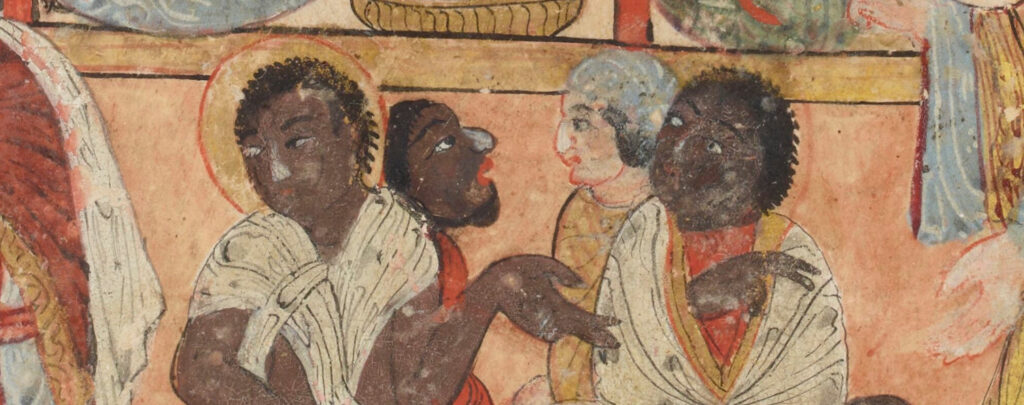
Only those knowledgeable about Islam and its History will believe that the first muezzin who called Muslims to prayer was black and of slave origin. The life of Bilāl b. Rabāḥ al-Ḥabašī is characterized by legend, above all by heroic deeds. Bilal, the son of an Arab and an Abyssinian slave, refused to publicly renounce his belief in the divine oneness then being preached by the prophet Muḥammad, despite the bloody punishment decreed by his master that could have led to his death. From then on, his deeds in the service of the nascent Arab-Islamic empire wouldbe remembered as a model of purity, respect and fidelity, becoming an exemplar of emancipation for black populations.
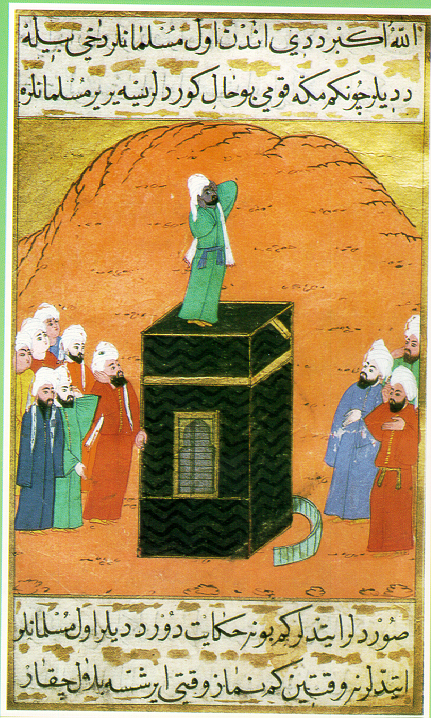
The figure of Bilal and the universalist vocation of Islam – which considers all human beings, i.e. Muslims, as equal before God – promote the manumission of slaves (‘itq) mainly as a pious act and/or as compensation for legal or religious debts. However, although numerous hadiths and Quranic passages pointin that direction, the reality of this civilization was different, for not only did it not resist putting an end to this form of human dependence, but it was one of the societies that benefited most from such activities. The intentionality of the law and the transformative thrust of the movement’s beginnings is one thing, but their application by an expanding society is quite a different matter.
The starting point is pre-Islamic Arabia where slaves were abundant, not only blacks but also whites and even people of Arab origin. Blacks came mainly from the Horn of Africa (Zanj) and surrounding areas, an area with which the Arabian Peninsula had maintained cultural, political and commercial relations since the dawn of time. There they performed all kinds of tasks, domestic, agricultural and artisanal. In a society highly organized around blood ties, clans and their internal hierarchies, having a black parent was reason enough to be marginalized.
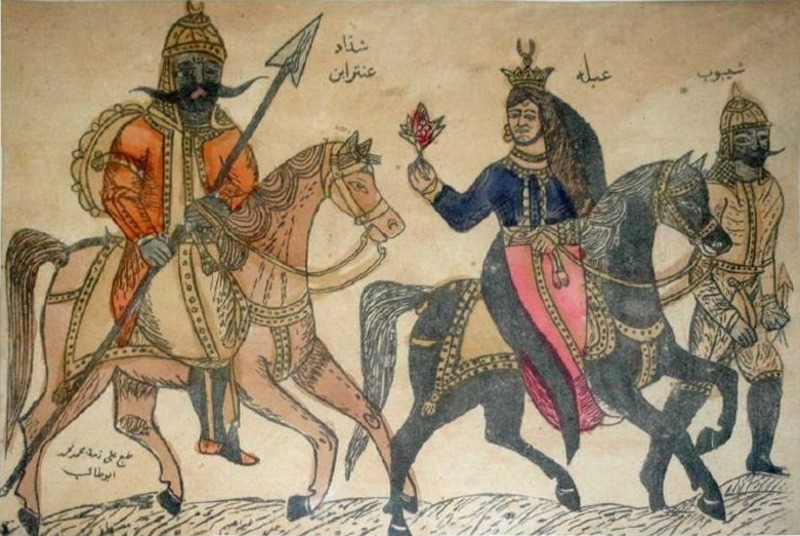
However, these prejudices could be overcome an individual performed great deeds for the prosperity and welfare of his tribe. Then the banished exile became a man of honor and the rootless man a hero. Indeed, there are many examples of this. Thus, some of the characters that make up the cultural substratum and the collective Arab subconscious were black or of mixed race, and clearly of slave origin. We recalled earlier the case of Bilal, but in the Age of Ignorance (the jāhiliyya, as the Muslim Arabs call the period before the arrival of Islam) two figures stand out. The first was Šanfara (lit. “the broad-lipped”), the son of an Abyssinian slave girl and one of the leading poets of Arab civilization to whom some attribute the authorship of the Lāmiyyat al-‘arab, one of the best-known sagas of Arab literature. The second, ‘Antara bin Šaddād, the son of an aristocrat belonging to one of the main tribes of Arabia and of an Ethiopian princess captured in one of the many razzias that were directed against Aksum, was the composer of one of the mu’allaqāt, poems that, according to legend, were written on cloth and hung from the Ka’ba. Both personalities embody the same characteristics, they are the descendants of blacks, marginalized because of their skin color and origins, who had to perform deeds of extraordinary merit to gain recognition from their tribesmen. They both succeeded and became a reference for the entire Arab civilization.
These are exceptions, though undoubtedly of great relevance for the indelible mark they left. However, as we pointed out, if the spirit of the new religion, in its initial moments encouraged the emancipation of slaves, as a pious act, when the politico-religious project became an empire, that was pre-eminently Arab and, of course, Islamic, not only did it not give up one of its main sources of revenues but this increased exponentially. We must not forget that taking captives in the land of the enemy (dār al-ḥarb) was permitted. This was seen most clearly when black Africa was integrated into Mediterranean trade networks. In the East, there had already been reports of this. The rapid increase in black slaves and their overexploitation became evident in the great capital, Baghdad, where exploitation and subhuman treatment lead to the revolts of the zanj (black slaves from the horn of Africa). It was then that thousands of blacks organized themselves and rebelled in favor of an alternative regime that lived by systematically plundering the main cities. Few scholars and specialists have stopped to explain these revolts that kept in check the main world power of the time, namely the ‘Abbāsid caliphate, and that, in the third of these uprisings (869- 883) would even go so far as to found a new rebel capital, al-Mukhtara (the chosen one), northwest of Basra.
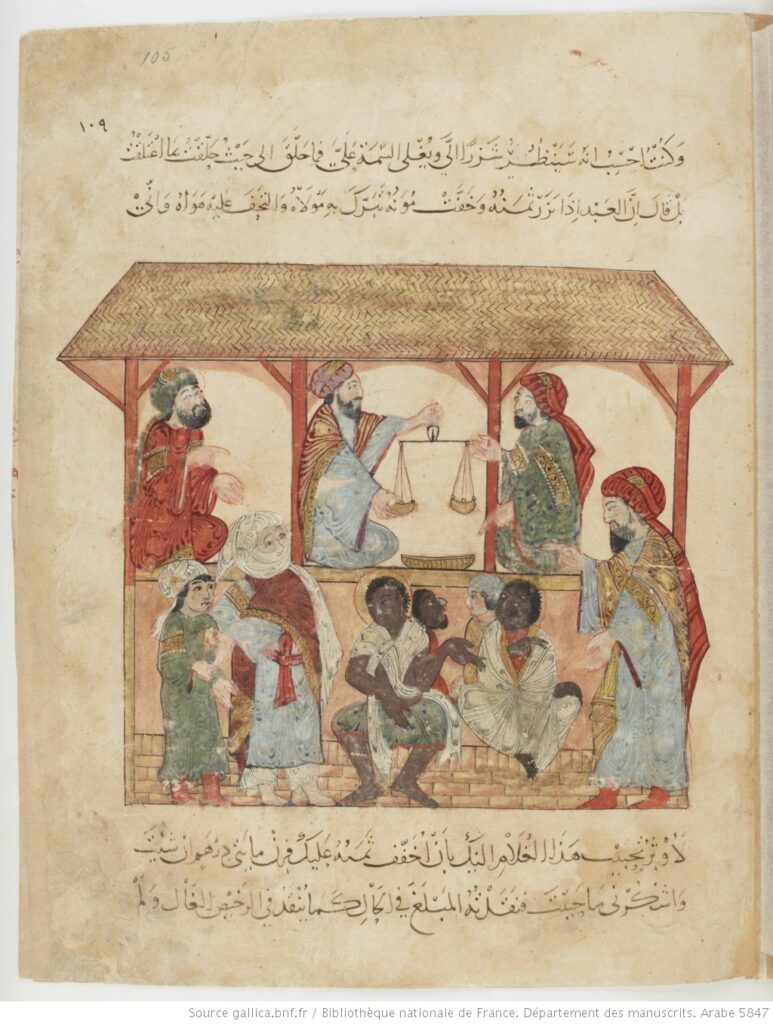
Prejudice and scenes in which black slaves are vilified are frequent in poetry and literature. Recall the figure of the Negro in the 1001 Nights or the satire that the poet al-Mutanabbī dedicates to the Ikshidid eunuch Kāfūr, vizier of Egypt.
I am astonished to see your feet in sandals
For I have seen you barefoot in sandals,
You are so ignorant that you yourself do not know whether you are black
Or have become white
The strap of your heel reminds me of the crack that you flaunted
There
When, naked, you walked clad in pitch.
If it weren’t for people’s big mouths
You would not have learned of the satire buried in my praise
And you would have jumped for joy at what I recited,
though it was riddled with satire.
If you grant me nothing good,
At least I enjoyed looking at your snout.
It seems you were brought from a faraway land
To make the mourners at a funeral laugh.
Veglison, 1997: 191 poetry no. 152.
The real contact between Islam and black Africa, however, takes place in the West of the then known world. When the Arabs arrived in North Africa, geographers and chroniclers began to describe with enormous prejudice and loaded with fanciful elements the peoples of black Africa, which they call Bilād al-Sūdān. Authors such as al-Mas‛ūdī (10th c.), al-Bakrī (11th c.) or al-Idrīsī (12th c.) loaded their accounts with myths and legends of anthropophagy, polyandry and barbarism. Even Ibn Khaldūn (14th century), an example of Arab rationalism, did not hold back. The Tunisian historian of Sevillian origin dedicated several passages to the blacks:
The behavior of the Blacks is characterized by lightmindedness, inconsistency and exuberance. They are given to dancing and eccentricities as soon as they hear music, in all countries. According to the philosophers, the reason for this is that the nature of joy and happiness is to cause expansion and release in their animal spirit.
For his part, the best-known traveler of Islam, Ibn Baṭṭūta (XIV century), is struck by the submission of blacks to their ruler (mansa), but also by the freedom that women enjoy to interact with their male counterparts alone, as highlighted in another article in this magazine.
In spite of the negativity of these views, it is important to insist that the construction of the “other”, in this case, owes less to the fact of belonging to another ethnic group or color than to belonging to religions other than Islam, most of the time polytheism In fact, we observe as much prejudice and sometimes even more negativity towards the Christians of the Iberian Peninsula, who are described as rude, dirty and barbaric. The ideological construction of supremacism and the consequent inferiority of blacks will have to wait several centuries, but it is obvious that by dint of an increasing association of slavery with negritude, the signifier “black” (and its versions zanj/ aswad/ agnau, the latter in tamazigt) would eventually become synonymous with slave and inferior being, as had happened in Europe with the term Slav, origin of slave.
The Islamization of sub-Saharan Africa by the Amazighs
When the Europeans arrived in the Senegal River, they did not know anything about this part of the continent. On the other hand, the Arab traders and, above all, the Amazighs, had been trading, residing and dealing with the natives for centuries. It is not for nothing that the name given to this country is that of one of the Berber tribes, the Zanaga, although the popular Senegalese etymology goes so far as to point out that it derives from Suñu Gaal (wolof), our canoe. Centuries of relations made the Berbers become the real Islamizers of the sub-Saharan populations, who converted to Islam in a quasi-bloodless way and mainly at the mercy of commercial and cultural exchanges. Numerous are the traces of the Amazigh in the black African languages as well as the borrowings in what concerns the celebrations and religious matters, words so deeply disseminated such as tajabone (title of the famous song of Ismael Lo which means feast of breaking the fast), timmis (prayer of the sunset), tabaski (al-‘īd al-kabīr, popularly known as feast of the lamb)… are part of the shared identity between Berbers and sub-Saharan Africa. Conversion takes place in a pyramidal fashion. First, it was the elites who adopted Islamic customs through their relations with the merchants.
In a second phase, when the sultans and the court are Islamized, the rest of the population would convert, without causing the abandonment of some previous beliefs, giving rise to interesting syncretisms. The Islamization that comes along with a minimal Arabization integrates the cultural and religious universe and favors the economic one. By virtue of it, some prejudices towards the blacks disappear, and even a certain admiration is observed towards the new elites who are becoming Islamized. We should not forget that the founder of Sijilmāsa, ,Isā b. Yazīd or Mazīd al-Aswad (140/757- 155/771), was black, something that suited the Khāriji-Ṣufri ideology of the Ayt Midrār, although they deposed him under the pretext that all blacks were thieves, they captured him and left him to die tied to a tree. And likewise we know that the Almohads came to sanctify some black characters from Ibn Tūmart’s entourage, such as Muslim al-Gnāwī, Abū Muḥammad Wasnār, Aghuwāl, Mimūn al-Kabīr, Mimūn al-Ṣagīr and Iburak Isamgan.
And it is worth mentioning the case of Mansa Musa, emperor of Mali, whom the Arab sources shower with praise, highlighting his generosity and pious character. This figure, deserving of an extensive article in itself, became famous in the Mediterranean world for his pilgrimage to Mecca, which brought together, not for the first time but more clearly than ever, black Africa, the Arab-Islamic world and European merchants. The expedition earned him a great deal of praise, his entourage and his enormous expenses – which led to a significant devaluation of gold – were highlighted. The relationship between black Africa and gold was consolidated in Europe at the time, Arabs and Berbers had already known it for a century. Symptomatic of this is the image, with a scepter, crown and, most importantly, with a huge nugget of gold in hand, with which the mansa is represented in the Atlas of the Majorcan Jew of Abraham Cresques (1375), one of the jewels of our cartography.
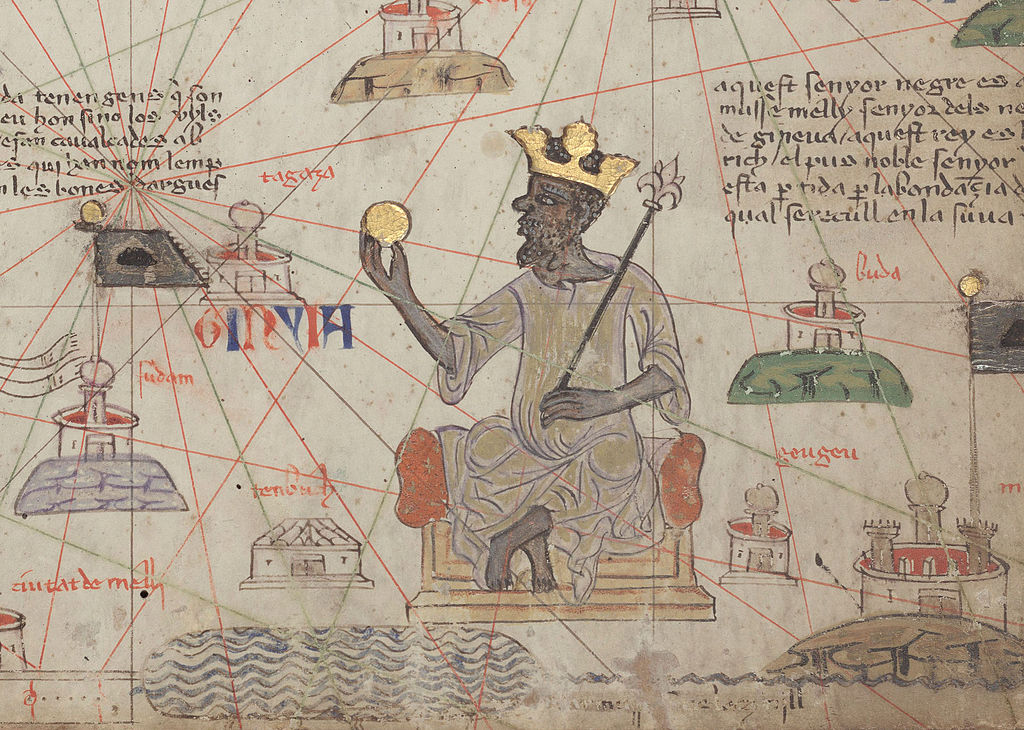
However, Islamization, which implies integration, better knowledge and the dynamization of contacts, also generates a series of transformations and inexorable effects in these sub-Saharan societies. The integrated elites would become, on the one hand, disseminators of the new religion, and, on the other, delegates of the black slave trade, in theory only non-Muslims, but in practice also of that creed. So if these empires of the Bilād al-Sūdān had always put on the market a significant number of slaves arriving in the Maghreb, al-Andalus and the rest of the known world, from then on the systematic capture of non-Muslim Africans from the savannah areas and surrounding areas was accelerated. All this would be the beginning of what, on a large scale, and integrating large monoculture farms, Europeans would carry out from the 15th and 16th centuries onwards. The pioneers of this, without any doubt, would be the Portuguese, already established on the Atlantic coast since the beginning of the 15th century.
Further reading:
- BOVILL, Edward W.: The Golden trade of the Moors, London: Markus Wiener Publishers, 1968 (reed. Of the 1933 ed.).
- BURESI, Pascal y GHOUIRGATE, Mehdi: Histoire du Maghreb médiéval (XIe-XVe siècle), Paris, Armand Colin, 2013.
- DI TOLLA, Anna M: “Midrār (Banū) ou Midrārides”, Encyclopédie berbère [Online], 32 | 2010, document M113, Online from 06 Novembre del 2020, connection on 23 September 2021. URL: http://journals.openedition.org/encyclopedieberbere/599 ; DOI: https://doi.org/10.4000/encyclopedieberbere.599.
- HEERS, Jacques: Les négriers en terres d’islam : la première traite des noirs, VIIe-XVIe siècle, Paris: Perrin, 2003.
- IBN BAṬṬŪṬA: A través del Islam, ed. and transl. Serafín Fanjul y Federico Arbós, Madrid: Alianza Literaria, 1981.
- IBN KHALDŪN: Kitāb al-‘Ibar, Beyrouth, 1968, transl. Part. Histoire des berbères por William Mac Guckin de Slane, Paris: Paul Geuthner, 1927.
- KĀTĪ, Maḥmūd: Tā’rīj al-Fattāŷ fī ajbār al-buldān wa-l-ŷyūš wa-akabir al-nass/Crónica del investigador sobre la historia de los países, los ejércitos y los grandes personajes, french transl O. Houdas y M. Delafosse, Paris: Ernest Leroux, 1981.
- KI-ZERBO, Joseph (dir.): Histoire générale de l’Afrique. IV. L’Afrique du XIIe au XVIe siècle, Paris: UNESCO, 1991.
- LEWICKI, Tadeusz: «L’État nord-africain de Tāhert et ses relations avec le Soudan occidental à la fin du VIIIe et IXe siècle», Cahiers d’Études Africaines, vol. 2, nº 8 (1962), pp. 513-535.
- NIANE, Djibril T.: Le Soudan occidental aux temps des grands empires, s. XI-XVI, Paris: Présence africaine, 1975.
- SÉNAC, Philippe and CRESSIER, Patrice: Histoire du Maghreb Médiéval VIIe-XIIe siècle, Paris: Armand Colin, 2013.
- VEGLISON, Josefina: La poesía árabe clásica, Madrid: Hiperión, 2005.