The earliest account of the battle of Covadonga is a tendentious reconstruction that has assembled a variety of hagiographic and liturgical materials and constitutes a literary topos rooted in classical literature. It is therefore clear that the account is not, strictly speaking, historical. That said, can any elements be recovered as historical?
Carlos de Ayala Martínez
Universidad Autónoma de Madrid

Few people today accept as historical the battle of Covadonga as it appears in the two earliest accounts of the event, the two versions of the Chronicle of Alfonso III, written around the year 900. The current majority opinion among specialists places Covadonga in the realm of the mythical without denying it a degree of historical reality.
In any case, it should be noted that this is a strange myth. On the one hand, of the historical event on which it is based, we do not know exactly where it took place, nor do we know precisely when it took place, nor even who the real contenders were. For a founding historical event this is surprising to say the least. But on the other hand, we are starting from events that would have taken place approximately 200 years before the first unequivocal written record of them, in the chronicles mentioned above. And that record then fell into oblivion for almost another 200 years, only to be revived in the first decades of the 12th century. However, it was not until the middle of the 13th century, with the influential Latin historians Lucas de Tuy and Jimenez de Rada, and above all, through the Alphonsine scriptorium, that the episode was revitalised and irreversibly became the official version of the beginning of the «Reconquest», a version that would survive for centuries.
Let us first recall how little we know about the historical basis of Covadonga and then go on to outline an explanation for the irregular trajectory of the mythical version of the event. The reconstruction of a historical event normally depends on three variables: place, protagonists and dating. The double account of the Chronicle of Alfonso III provides us with details of the first two variables, and it is only the third that is merely hinted at.
The place is Mount Auseva, in the Picos de Europa, very close to Cangas de Onis, around a cave —coba dominica or coua sancte Marie—, whose surroundings, if the story is to be believed, would have been extensive enough to erect tents around the cave and install siege engines —fundibolos— as if the target were a powerful fortification.
The chronicle also describes the identity of the contenders with precision. Pelayo dominates the Christian faction and is presented as a high magnate of the Visigoth court, related to its kings, who had suffered oppression by the Muslims, and as a result settled with his sister in Asturias. Incomprehensibly, the Muslim governor of Gijon entrusted him with the task of representing him in Cordoba, a circumstance that the governor took advantage of to seduce Pelayo’s sister. This was a fateful moment at which a plan for the «salvation of the Church» was finalised in Pelayo’s mind. The Cordovan authorities then ordered the capture of the Christian, who fled to Mount Auseva, where he was elected «prince» by the Asturians. The Cordovan authorities sent a powerful army of biblical proportions against him —187,000 men— under the command of a general, and accompanied by the bishop of Toledo —or Seville— Oppa, son of Witiza, who was put in charge of a negotiation destined to fail. Any attempt to grant historicity to the story, such as that once argued by Sanchez Albornoz, is in vain. The whole thing is a compendium of literary cliches, hagiographic cliches and resources from the liturgical world.

The data provided by the Chronicle of Alfonso III points to an early date, which is the one supported by those who defended the historicity of the account, specifying it as 718. There are two other alternative dates, the one proposed by Sánchez Albornoz himself on the basis of Islamic materials, 722; and a third, much later one that I personally consider more reasonable, 737, which is defended by those who believe they can see in a text of the Mozarabic Chronicle of 754 the earliest account of the events of Covadonga, albeit an account that mentions neither this place nor Pelayo, but which does mention circumstances that could allude to the event and which, in any case, would correspond to the years of rule of a Andalusian wālī.
A first step, before proposing a hypothetical reconstruction of the famous battle of Covadonga, is to determine the profile of its main protagonist, Pelayo. He is undoubtedly a historical figure, whom a persistent memory dating back to the beginning of the 9th century has associated with a resistance movement against the Andalusi government and the beginning of a new dynastic legitimacy; it should be noted, however, that this memory does not allude to Covadonga at all. Nor do later Islamic reports, none of them earlier than the 10th century, although they do refer to a specific battle between Pelayo and the Muslims, a tradition that would last for centuries: a group of 300 rebels led by Pelayo escaped the control of the Andalusi authorities and made a stronghold in the mountains; weakened by the Muslims, they survived, initially ignored by the Islamic troops, by feeding on-honeycombs-made by the bees in the cracks of the mountain.
Within this framework, what reconstruction of the events can be undertaken? We start from the assumption that the fundamental account, that of the Chronicle of Alfonso III, is a self-serving reconstruction that has assembled diverse hagiographical and liturgical materials and that, as far as the battle of Covadonga in particular is concerned, it constitutes a literary cliche —the refuge of the «good» on a mountain, surrounded by the wicked in which they experience the salvific action of the divinity through miraculous deeds— which has its roots in classical literature. It is obvious, therefore, that the story is not properly historical.
However, what elements can be salvaged? Firstly, that Pelayo led the resistance of a group of Christians in a mountainous area in the north of the Iberian Peninsula is not debatable. And that he was a nobleman linked to the Visigothic Officium palatinumum, rather than a member of the royal family itself, is also quite probable. From here the doubts begin.
Was this resistance the result of a rebellion or a response to a foreseeable but not directly provoked attack? The rebellion thesis dominates the historiographical landscape among both early authors and modern interpreters of the events. It is clear that this explanation is better suited both to Christian propaganda —a rebellion is a more dignified framework for the start of a legitimising process— and to that of Muslims —a rebellion can be interpreted as treason— but the arguments justifying the rebellion are not very convincing. They are based on such unverifiable facts as the role of Pelayo as an envoy to Cordoba or the presence of Bishop Oppa among the troops sent to put down the rebellion. It is probably more reasonable to think in another, less heroic key: that incomplete Islamic control of the Peninsula favoured the existence of resistant indigenous nuclei — indigenous does not mean non-Romanised— who probably tried to guarantee their independence through alliances with nobles from the south who, like Pelayo, were familiar with the use of arms. At a certain moment this situation might have been particularly harmful to Andalusian interests. When, for example? The account in the Mozarabic Chronicle of 754 and the possible date of 737, after the Poitiers disaster of 732, looks convincing: the Andalusis would then have decided to eliminate pockets of resistance south of the Pyrenees. This argument may gain support from the fact that the failure to attempt this elimination did not provoke new attacks, which would have been unavoidable if we were dealing with an active rebellion, and that the Muslims rather looked the other way until, as the Islamic sources say, they became aware of the problem much later.
From the outcome of the confrontation, we can recover only the reality of the difficulties of deploying a large army —which might be justified as a deterrent— moving through a rugged landscape, which undoubtedly determined the failure of the operation. Did it take place at the site with which tradition has associated it over the centuries? There would be no objection to that; such a tenacious belief was probably not born out of nothing. In any case, if it had not taken place near Mount Auseba, an alternative site would have been equally mountainous.
That the outcome of that operation was disastrous for the Muslims is clear. Christian and Islamic sources are unanimous. It is only natural that from this point onwards, a founding myth was elaborated, with an aura of miracle. However, the role of the Virgin is a later addition. The miracles refer directly to God. Mention of the Virgin is limited to indicating the location of the coua sancte Marie, where stones thrown by the Muslims bounced off harmlessly. The Virgin is therefore far from taking on a military role that popular Marian piety, not yet highly developed, could not have conceived of. Therefore, even if the frustrated Islamic operation against Pelayo’s followers had really taken place on the slope of Auseva, it would certainly not have been called the Battle of Covadonga until later.
After the Alphonsine chronicle cycle, the subject of Covadonga was marginalised in the political panorama of the kingdom of Leon until it reappeared with force in the first decades of the 12th century in the so-called Historia Silense, an anonymous chronicle written in the service of the Leon monarchy, probably in circles close to the collegiate church of San Isidoro. The Historia Silense takes on the content of the Chronicle of Alfonso III, but adds nuances and information of its own. It shows itself to be familiar with the setting of what it does not hesitate to call the «holy cave», where, in its opinion, up to a thousand men could have been accommodated. It emphasises the prominence of the Virgin, which was not so evident in the original source, and testifies to the fact that the place was then the object of veneration. But, above all, the Silense adds a colophon to the Pelagian account in the form of an idealised summary describing how the Gothic people were reorganised in the new political formation born of Covadonga, and how this reorganisation rested on three fundamental pillars: military discipline, compliance with the legitimate government, and the restoration of churches and their worship to guarantee the praise of God.

However, although the recovery of the Pelagian discourse must therefore be related to the neo-Gothic ideology linked to Saint Isidore, there is no doubt that this discourse was taken up almost immediately afterwards in Oviedo, the original capital of the Asturian-Leonese monarchy, by Bishop Pelayo of Oviedo (1101-1153) and the project for the aggrandisement of his church. The bishop was clearly interested in emphasising that the origin of the legitimacy of the Leonese monarchy rested on what happened at Covadonga, the heirs of whose protagonist soon moved their capital to Oviedo. Bishop Pelayo, in fact, incorporated the account of the victory of Covadonga from the Chronicle of Alfonso III into a compilation of chronicles, the so-called corpus pelagianum, probably composed between 1120 and 1142. The bishop’s interest in recovering the Pelagian discourse and the symbolism of Covadonga was such that he went so far as to enrich the account with a legendary development involving another of the hallmarks of the old Asturian monarchy, namely the well-known Cross of Victory, donated in 908 by Alfonso III to the church of Oviedo. The legend, which until very recently was attributed to the 16th century and which we can now easily trace back to the 12th century, is that the cross was raised by Prince Pelayo on the victorious day of Covadonga, after a mysterious celestial apparition.
The advantage of this rehabilitation of the story of Pelayo and the miracle of Covadonga is that it places the discourse of Reconquest in the early days of the Islamic occupation, giving it spectacular striking continuity, something that was not possible before. In any case, what we might call the «official recognition» of the story of Covadonga conclusively removes it from a Leonist, neo-Gothic tradition associated with the monastery of San Isidoro —and also with the seat of Oviedo— which had recovered it around 1100, to incorporate it into the discourse of the Castilian-Leonese monarchy from the 13th century onwards. Here the man who played the key role in this transfer and «made official» the Pelagian discourse and the legitimacy forged at Covadonga for a monarchy, the Castilian monarchy, ready to recover the political-religious unity of former times, was Archbishop Rodrigo Jimenez de Rada. To him we owe the definitive and «canonical» version of the Pelagian mythology, based, of course, on the previous tradition, but with the Archbishop’s own accents and nuances.
The providential message of Pelayo’s involvement is emphasised: he is the «little ember» that the Christian people preserved after the ruin of Hispania, who comes to join the «few remains» of those who in the northern mountains kept before God the torch of the saints in Hispania, while also emphasising the sacredness of the setting of Covadonga, whose cave is surrounded by an impregnable rock, «as if by a divine act». The construction of the Pelagian discourse and the victorious day of Covadonga was thus fixed for the future, at least in its broadest outlines. In fact, the scriptorium of Alfonso X was responsible for popularising it on the basis of the Toledan text, adding practically nothing, but recovering the central importance of Marian intercession at Covadonga, which was developed at the time by the Historia Silense, but was somewhat obscured in Jimenez de Rada’s account.
The Pelagian myth, understood as the discourse created and recreated around the origins of an Asturian monarchy providentially called upon to restore «lost Spain» following the Islamic conquest —a discourse whose historical basis is weak and not well known— played an important role in the legitimisation of the war against Granada concluded at the end of the 15th century. The chroniclers of the Catholic Monarchs, and Fernando del Pulgar in particular, gave a full account of it.
Only one significant detail was missing to crown such an extraordinary propagandistic construction: the consideration of Pelayo as a saint. It was a step that would not be taken in the Middle Ages and that would appear for the first time in the work of an author of the second half of the 16th century, the Basque historian Esteban de Garibay, perhaps based on the fanciful data provided a century earlier by Pedro de Corral in the so-called Saracen Chronicle.

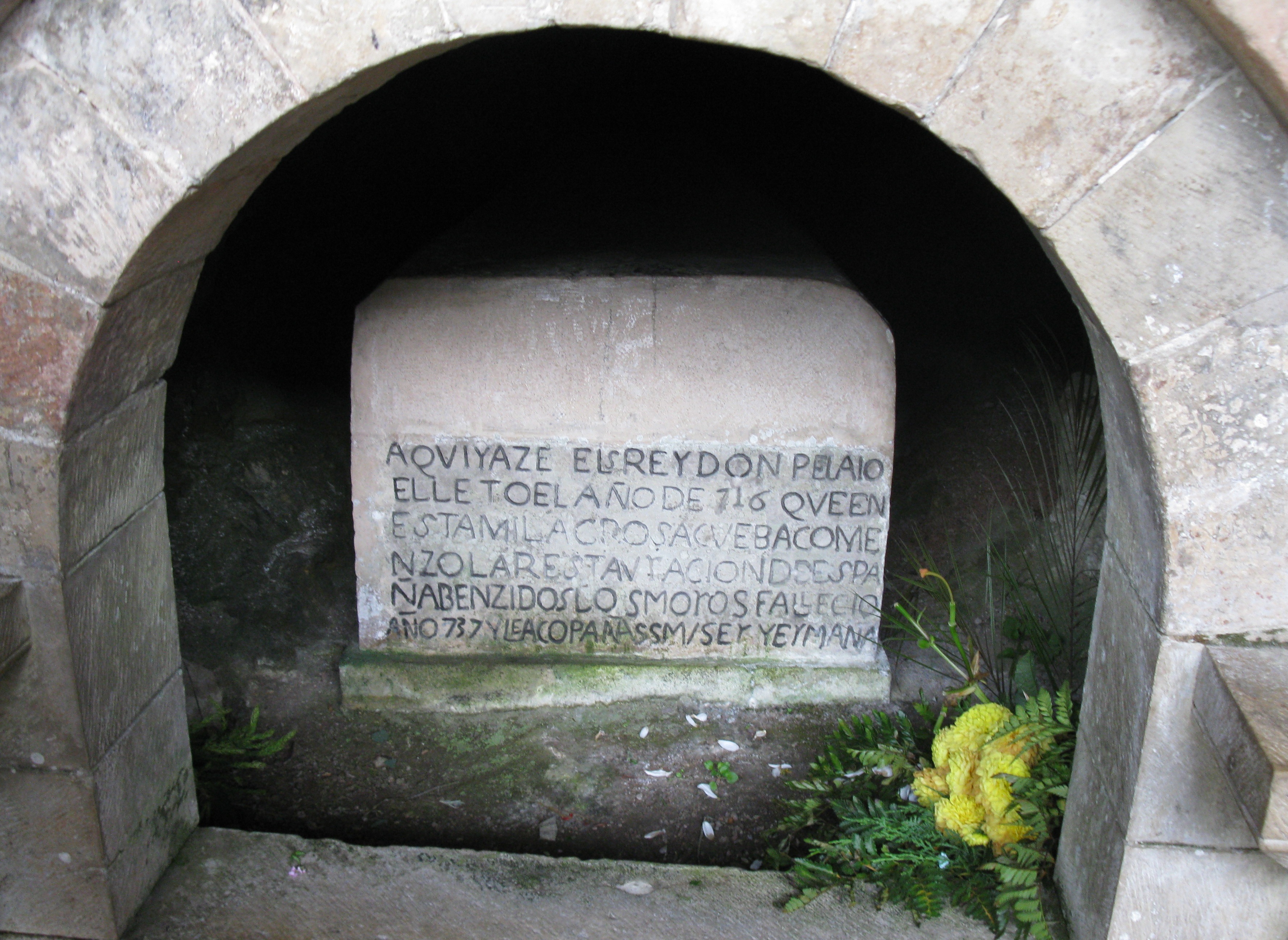
All in all, the sanctification of Pelayo did not stand the test of the rationalist impulse among Spanish historians from the last third of the 17th century onwards, on the eve of the «Age of Enlightenment». This did not mean, however, the renunciation of the propagandistic nature of a Pelagian discourse which, from an only moderately secular perspective, served to forge the patriotic nationalism of the early 19th century. In any case, it is worth remembering that it was Catholic traditionalism that encouraged the Bourbon restoration of 1876, which in turn revived the Pelagian discourse, given material expression in the construction of the present-day basilica of Covadonga between 1877 and 1901, and kept alive in the popular imagination through the curiosity aroused by the supposed tomb of the hero that can still be seen in the «holy cave»; a discourse, moreover, which in political terms was very active in national-Catholic circles of the Franco regime, and whose systematic deconstruction began only in the seventies of the twentieth century. Today we can affirm that, viewed as a discourse of historicist pretension as such, rather than merely as an ideology of political justification, it is already a thing of the past, at least in academic circles. All that remains is the most important thing: to reach a definitive agreement on its historical basis.